
Ypres Tour – Day Two (Saturday 3rd September 2022)
Breakfast at the Hotel was buffet style, with a large, varied choice of cooked and continental foods, so many choices to set us up for the day Bob had planned for us, visiting Essex Farm Cemetery, Pond Farm, Tyn Cot Cemetery and Hooge Crater Museum, all within a few miles of Ypres.
Our first stop of the morning was Essex Farm Cemetery, it was in Essex Farm Cemetery that Lieutenant-Colonel John McCrae of the Canadian Army Medical Corps wrote the poem ‘ In Flanders Fields’ in May 1915.
He was inspired to write it on May 3, 1915, after presiding over the funeral of friend and fellow soldier Lieutenant Alexis Helmer, who died in the Second Battle of Ypres. According to legend, fellow soldiers retrieved the poem after McCrae, initially dissatisfied with his work, discarded it. “In Flanders Fields” was first published on December 8 of that year. Flanders Fields is a common English name of the World War I battlefields in Belgium and France.
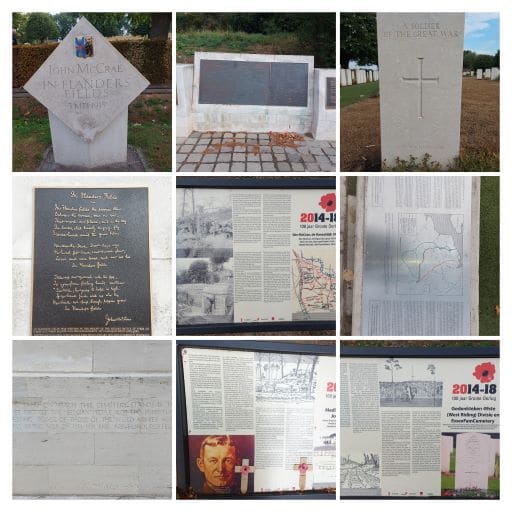
It is one of the most quoted poems from the war. As a result of its immediate popularity, parts of the poem were used in efforts and appeals to recruit soldiers and raise money selling war bonds. Its references to the red poppies that grew over the graves of fallen soldiers resulted in the remembrance poppy becoming one of the world’s most recognized memorial symbols for soldiers who have died in conflict.
In Flanders Fields
BY JOHN MCCRAE
In Flanders fields the poppies blow
Between the crosses, row on row,
That mark our place; and in the sky
The larks, still bravely singing, fly
Scarce heard amid the guns below.
We are the Dead. Short days ago
We lived, felt dawn, saw sunset glow,
Loved and were loved, and now we lie,
In Flanders fields.
Take up our quarrel with the foe:
To you from failing hands we throw
The torch; be yours to hold it high.
If ye break faith with us who die
We shall not sleep, though poppies grow
In Flanders fields.
The land south of Essex Farm was used as a dressing station cemetery from April 1915 to August 1917. The burials were made without definite plan and some of the divisions which occupied this sector may be traced in almost every part of the cemetery, but the 49th (West Riding) Division buried their dead of 1915 in Plot I, and the 38th (Welsh) Division used Plot III in the autumn of 1916.
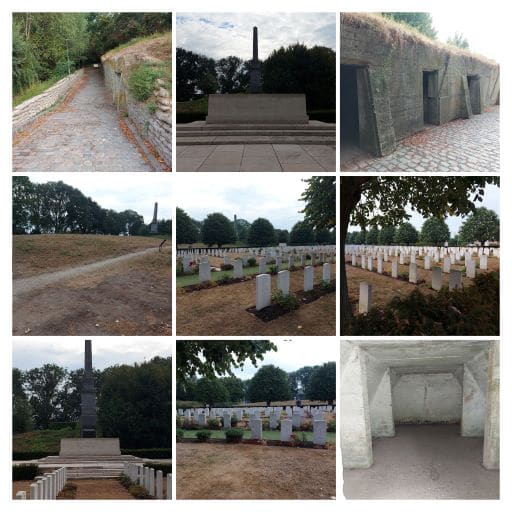
There are 1,200 servicemen of the First World War buried or commemorated in this cemetery. 103 of the burials are unidentified but special memorials commemorate 19 casualties known or believed to be buried among them.
The 49th Division Memorial is immediately behind the cemetery, on the canal bank.
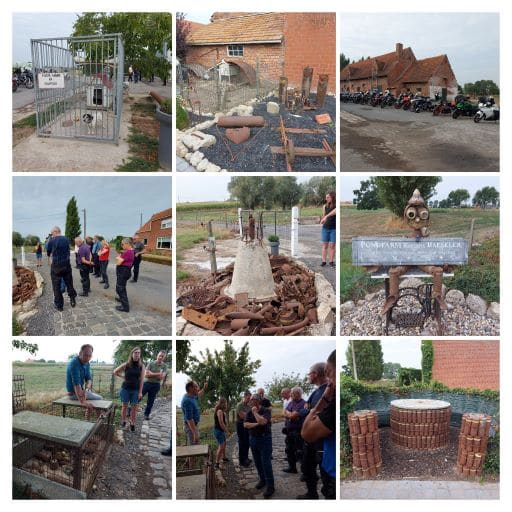
Our second stop for the day was Pond Farm and the home of WW1 replica tank “Deborah”, here we were greeted by Stijn (as well as Charlie the farm dog) who took us on a tour of Pond Farm and explained the history behind the farm.
By July 1917 the German Army had reinforced their bunkers and their defence lines with underground tunnels, several farms, including Pond Farm, became real small fortresses. At Pond Farm three large German bunkers of about 40m length were located, as well as a number of smaller bunkers, underground tunnels and cellars. A narrow gauge railway, located just behind Pond Farm, was used for transporting most of the materials and equipment to these bunkers.
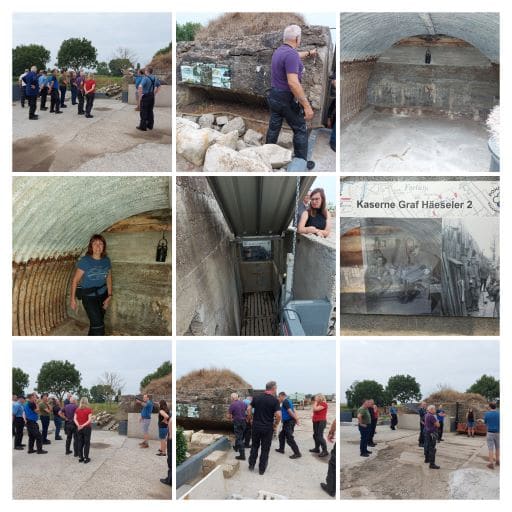
Whilst Stijn, Grandfather destroyed most of the bunkers, one still remains on the farm and during Covid Lockdown, Stijn restored the remaining bunker.
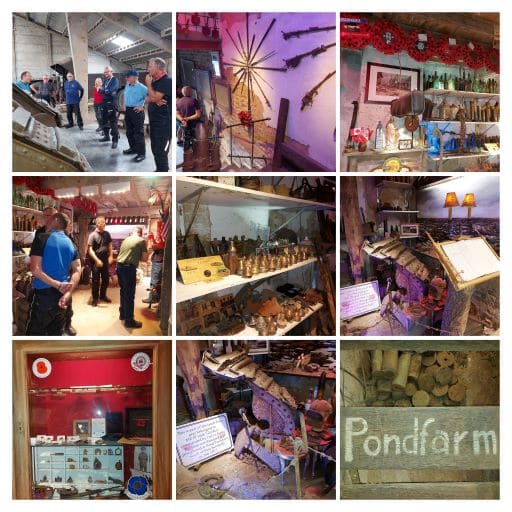
Stijn explained how he grew up on the farm, that was the centre of the front lines during WW1, at the time the farm was known as Pond Farm by the English, it is the region where many battles took place, Since 2003 he has been collecting relics, he has found, amongst other things, British rifles, bayonets, shovels, lead bullets, buttons and many types of shells and several grenades from Belgian, German, British and French origins. Dangerous munitions of the war are collected once a year by DOVO (a service to collect and destroy explosive ordnance.
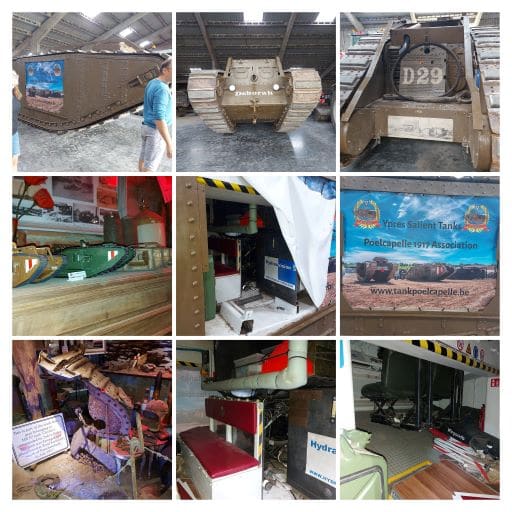
In June 2012, they accidently found two pieces of a WW1 tank, within two weeks in the fields on the farm, they included a piece of track and a piece of plate on the back of a tank. They then went on to build the replica tank, starting in 2013 and with work continuing even now.