
What do thirteen advanced motorcyclists do for entertainment on a wet Tuesday evening in October? Apparently, they train to become better HGV drivers!
Well, sort of…
PECAM’s social evenings are a wonderfully varied affair. Sometimes it’s a relaxed chat over a drink (usually low or non-alcoholic, of course), sometimes a guest speaker or practical demonstration, and during the warmer months we have even been known to venture out on our motorcycles in search of excellent fish and chips.
But Tuesday 20th October offered something a little different.
Our very own Bob A had persuaded thirteen hardy souls to brave the rain and wet roads to join him for an evening exploring the Fleet Operator Recognition Scheme (FORS) online training programme, normally aimed at professional HGV drivers.
Now, you might reasonably ask why a group of advanced motorcyclists would want to spend an evening learning about driving enormous lorries.
The answer is actually rather simple.
As motorcyclists, we share the roads with HGVs every day. Understanding what their drivers can see, what they cannot see, the technology available to assist them and the challenges of manoeuvring such large vehicles gives us valuable additional insight into managing the hazards they can present.
And hazard awareness, as we all know, is a fundamental part of advanced riding.
First Up: Cyclists
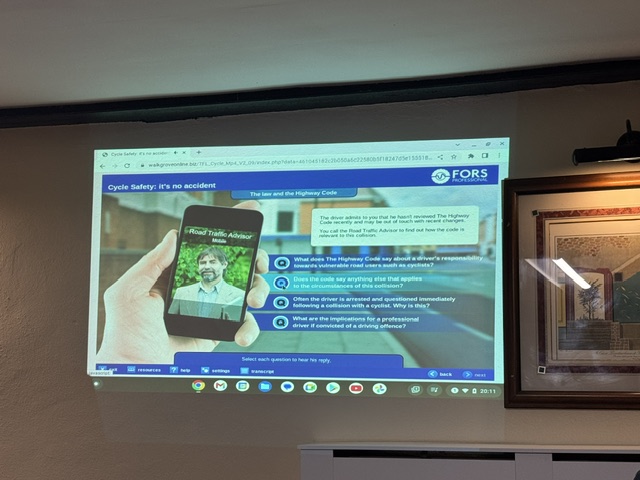
Our first challenge was the FORS Cyclist module, which examined a simulated collision involving an HGV turning left at a traffic-light-controlled junction and knocking a cyclist off her bicycle.
Rather than simply telling us what went wrong, the programme explored the incident from the perspectives of the various people involved. It examined the Highway Code, the responsibilities of different road users and what happens when the Police become involved.
It was a fascinating exercise in understanding how a relatively ordinary traffic situation can develop into a serious collision.
Although we ride rather faster than most cyclists, many of the underlying vulnerabilities are similar. Being difficult to see, occupying a relatively small amount of road space and being particularly exposed when things go wrong are all familiar challenges for motorcyclists.
Our collective brainpower was clearly working well, because we achieved 100% on the Cyclist module.
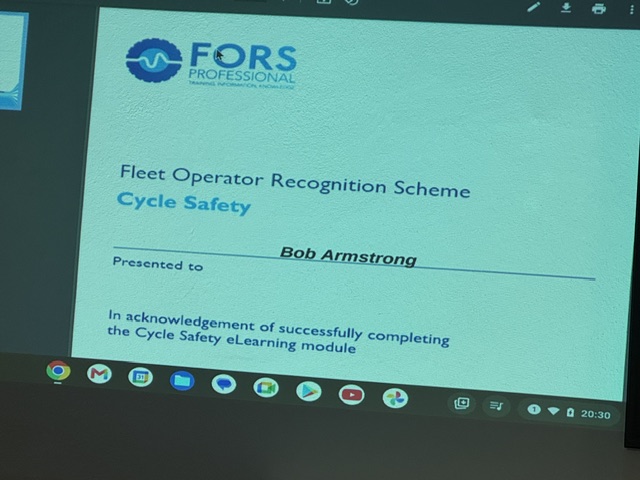
More importantly, Bob passed and earned his first module certificate of the evening.
Not bad for a Tuesday night!
Next Up: Pedestrians
The second module took a rather different approach.
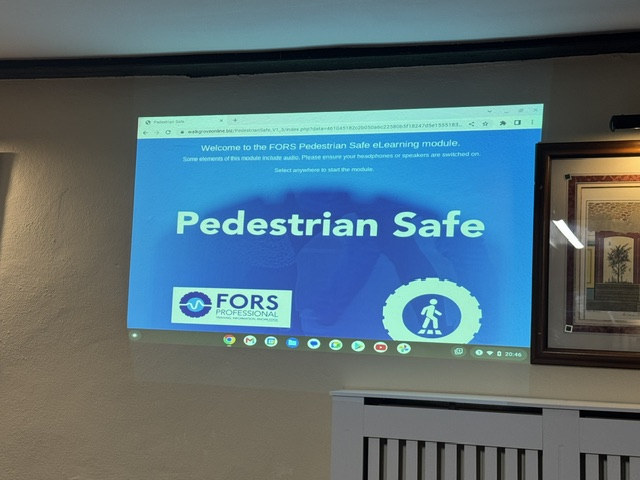
This time we worked through a series of driving scenarios, identifying vulnerable pedestrians, potential hazards and the difficulties HGV drivers face in maintaining a clear view of their surroundings.
We also explored something that probably doesn’t feature very often in motorcycle training: cab housekeeping!
An HGV cab is effectively a driver’s workplace, and loose equipment, paperwork and general clutter can interfere with visibility and create additional distractions.
The module concluded with five questions, of which three correct answers were needed to pass.
Our team managed four.
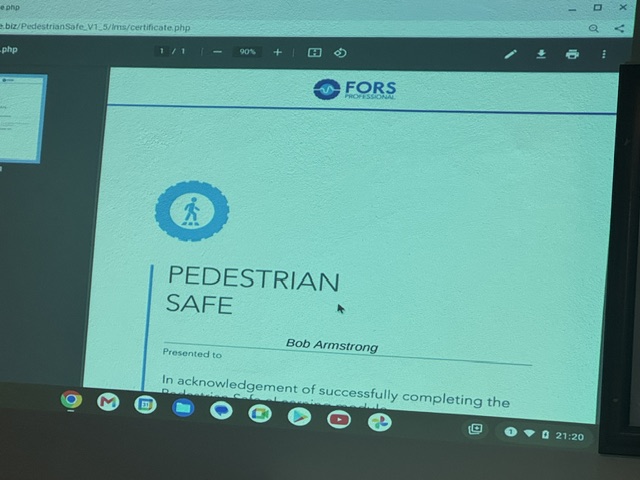
Another pass, another certificate for Bob, and apparently enough to put him on the road to — or possibly already at — FORS Bronze accreditation.
There was, however, one small controversy.
The question we got wrong asked us to identify the MOST vulnerable pedestrian. We selected the person we considered most vulnerable, only to discover that the expected answer included all the vulnerable people shown.
Now, we are quite happy to learn from our mistakes, but there was some spirited debate about the difference between most vulnerable and all vulnerable.
We shall leave the finer points of multiple-choice question design for another evening!
So, What Exactly Is FORS?
FORS stands for the Fleet Operator Recognition Scheme, a voluntary accreditation scheme for commercial vehicle operators.
It encourages higher standards in road safety, operational efficiency, environmental performance and risk management. Its accreditation is recognised across the transport and construction industries, with many organisations requiring FORS-accredited operators for work on their sites.
For us, the value wasn’t in becoming qualified lorry drivers. It was in seeing the road from a very different perspective.
Advanced riding isn’t simply about controlling a motorcycle skilfully. It’s about understanding the whole road environment, anticipating what other road users might do and recognising the limitations they face.
Knowing more about the challenges experienced by HGV drivers can only help us make better decisions when riding near them.
A Very Worthwhile Evening
A big thank you to Bob A for organising and hosting such an unusual, informative and thoroughly enjoyable evening.
Thanks also to the thirteen PECAM members who ventured out in the rain and contributed their observations, experience and occasional disagreement with the computer!
We came away with a better understanding of HGV operations, a few fresh perspectives on vulnerable road users and two successful module results.
And Bob came away with the certificates.
Which raises an interesting question: whose social evening was this, exactly?